













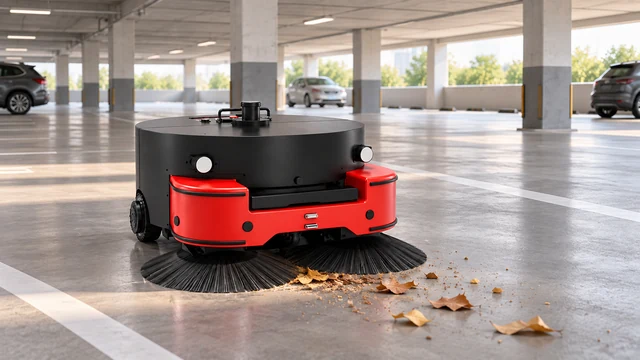
Support for bringing robotics into your organisation
Choosing a robot is one step. Integrating it also means preparing the site, defining the tasks and giving teams the bearings they need to use it. ÆNIX works out the right arrangements with you.

First of all
Understanding the site and how it is used.
Support starts well before delivery: with a shared reading of what actually happens in your spaces.
The areas and the floors
Which areas are concerned, which are not, and what floor coverings are actually there.
The tasks expected
What the robot is to handle, and what the teams keep doing — that split is decided here, not afterwards.
Footfall and hours
The slots genuinely available, the busy periods, the times when spaces are free.
Site constraints
Access rules, sensitive areas, presence of the public, internal obligations to respect.
The people involved
Who will use the machine, who will handle routine upkeep, who is told when something goes wrong.
The detailed check
Doorways, obstacles, thresholds, charging: the full list is prepared with the site readiness checklist.
See the checklistDeployment
Preparing for commissioning.
The exact content depends on the equipment chosen and on your site: these are the points that are always prepared.
Plan the routes
Defining zones, the order of passes and excluded spaces, then mapping carried out on site.
Secure access
Doors, time slots, a contact on site: the robot must be able to reach its areas at the planned times.
Choose the charging point
An accessible, clear location suited to the equipment. Power requirements are those stated in the model’s documentation and, if any work is needed, are a matter for your site’s qualified trades.
Configure
Settings, schedules and operating parameters matched to the equipment and to the constraints noted during the assessment.
- Moving between floors depends on the model, on the building’s equipment and on what has been agreed: it is never a given and is examined case by case.
- Any change to the site — a socket, a threshold, signage — is identified during the assessment and carried out by qualified people, not improvised on delivery day.
Training
Getting to grips with the solution.
The aim is not to train technicians, but to make teams self-sufficient in the intended daily use.
What the handover covers
- Start a cycle on the intended area
- Pause and resume work in progress
- Recognise the situations that need someone to step in
- Carry out the daily steps set out in the manual
- Know what is the site’s responsibility and what is ÆNIX’s
- Report a problem to the right person
The exact procedures — starting, stopping, emptying, replacing wear parts — are those in the chosen model’s documentation and in the training planned for the project. This page does not replace them.
Two different things
Routine upkeep and maintenance.
Confusing the two is a common source of disappointment: one is done on site every day, the other is for qualified technicians.

Routine upkeep, on site
- Carried out by the people designated at deployment
- Simple steps set out in the manual: hoppers, filters, brushes, water depending on the model
- Frequency tied to actual use and to site conditions
- Consumables and wear parts to budget for in operating costs
Maintenance, by qualified technicians
- Technical work on the machine, within the agreed scope
- Remote supervision handled by the ÆNIX technical team
- Scope, duration and exclusions set by the contract chosen
- To be distinguished from the daily steps your teams carry out
To check
What your proposal should spell out.
Nothing is ticked in advance here: this table is there to ask the right questions, including of a supplier other than us.
Wide table: scroll it sideways if needed.
| Item | What it covers | The question to ask |
|---|---|---|
| Site preparation | Mapping, definition of routes and excluded areas, any site changes noted during the assessment. | What does the supplier carry out, and what stays with the site? |
| Training | Handover for day-to-day users and for the designated contacts. | How many people, over what period, and what happens when staff change? |
| Consumables and wear parts | Parts that wear with use and have to be replaced. | Which ones, roughly how often, and how are they supplied? |
| Assistance | How to reach someone when there is a problem using the machine. | Through which channel, at what times, and for what kind of request? |
| Technical interventions | Work carried out on the machine by qualified technicians. | Which are covered by the contract, which are billed separately, and on what terms? |
| Warranty terms | Scope, duration and exclusions applying to the equipment chosen. | What does the warranty on the proposed model cover, and what is explicitly excluded? |
None of these lines is presented as included by default: the terms of an ÆNIX project are set out in the proposal drawn up after your site assessment.
Over time
Organising follow-up.
A machine stays in service when someone owns it and when observations get passed on.
Name someone responsible
A point of contact on site, known to the teams, who gathers questions and reports.
Write observations down
Areas covered poorly, repeated stops, recurring obstacles: what is written down can be fixed, what stays verbal gets lost.
Plan the review points
Regular reviews, at a frequency agreed with you, to adjust routes and schedules according to actual use.
Who prepares the site?
Preparation is shared. During the assessment ÆNIX identifies what needs planning — routes, excluded areas, charging point, access. Whatever concerns the premises themselves (clearing areas, access permissions, any works) is done by the site or by the trades it appoints. The split is set out in the proposal.
Who uses the robot day to day?
The people who already work in those spaces, trained during the handover. The point is not to create a dedicated role, but to fit a few simple steps — start a cycle, empty a hopper, report a problem — into an existing routine.
What is the difference between upkeep and maintenance?
Routine upkeep covers the daily or periodic steps set out in the model’s manual, carried out on site by your teams. Maintenance means technical work on the machine, carried out by qualified technicians within the agreed scope. Both are necessary and neither replaces the other.
Is maintenance included?
It depends on the contract chosen: its scope, duration and exclusions are set out in the proposal. We do not state a standard content on this page, because it varies with the equipment and the project. That is precisely the question to ask before signing, with us as with anyone else.
How do I report a problem?
Through the contact details agreed at deployment, via the site’s designated contact. Describe what was observed, in which area and at what time: those details are what separate a setting to adjust, an upkeep point and a technical intervention.
Project review
Let’s prepare for the machine’s arrival.
Describe your site and your organisation: we will work out the deployment, training and follow-up arrangements suited to your project.
- Business activity
- Spaces concerned
- Task considered
- Hours
- People involved
- Phone
- +33 5 33 04 12 27
- contact@aenix.fr
- Coverage
- Across France
Going further